Need further support?
Advice about children’s bladders and bowels – from birth, to potty training, to school
By the time they start school, it is possible for most children to be confidently wearing pants and independently managing all aspects of toileting, including wiping. This can only be achieved through timely potty training.
Potty training is a huge milestone in any child’s life, and preparation for it starts the day the child is born. For it to be successful, the child needs a healthy bladder and bowel.
Healthy bladders and bowels
The first six months
- Babies have very small bladders, so they do lots of little wees.
- The wee should be dilute, almost colourless, and never smelly.
- The frequency and consistency of small babies’ poo depends very much on how they are fed, but babies’ poo should always be soft, and should be passed at least every other day.
- Babies do get constipated – even breastfed babies.
- Read Baby poo - what to expect for more information.
- Keep your baby’s bladder and bowel healthy by paying attention to how much they feed. In warm weather, increase breastfeeding. If your baby is formula fed, offer cooled boiled water between feeds.
From weaning onwards
- As your baby grows, they will gradually wee less often, but they should always have several wet nappies or potty/toilet wees every day.
- School age children usually do 4 – 7 wees a day. To find out what a healthy wee looks like, see ERIC’s Wee checker – the wee should be clear, almost colourless, and never smelly.
- When your baby starts on solids, their poo will become thicker and darker. They may poo less often, but they should still continue to pass soft poo every day, or at least every other day.
- Find out what a healthy poo looks like with ERIC’s Poo checker. Type 4 is the ideal poo; type 5 is fine too. Types 1 – 3 suggest constipation. Types 6 and 7 can mean constipation too! Look at Advice for children with constipation for more information. Constipation does not get better without laxatives!
- Think about what your baby is drinking. Breast or formula milk should be their main drink until they are a year old, but the amount will decrease as they eat more food. A 7-9-month-old baby will drink about 600mls of breast or formula milk; a 10-12-month-old baby will drink about 400mls of breast or formula milk. From weaning onwards, add sips from a cup of water every mealtime - the amount of that will increase as they gain confidence with the cup.
- Continue to check your child has plenty of drinks as they grow: a minimum of 6 – 8 cups a day, of a suitable cup size for the child, which is about 120mls for a 2-year-old and 175mls for a 5-year-old.
- Spread the drinks out throughout the day – the bladder is made of muscle, so it needs regular exercise.
- Water is best, milk in moderation is fine and well diluted fruit juice or squash can be included too.
- Avoid caffeine, limit sugar and save fizzy drinks for a treat when they are older.
- For more information on how the bladder works and the 4 steps to a healthy bladder, read Children’s bladder health – what’s normal and what can go wrong.
Introducing the potty
Before they can start potty training, your child needs to be given lots of opportunities for potty learning. Potty learning means helping your child to use a potty or toilet as part of their overall learning; babies are born ready to learn.
Most children can start to learn potty skills from the time they can sit up, usually around 6 - 9 months. There’s no need to wait for ‘signs of readiness’ – follow the evidence- based 3 step Let’s Go Potty approach. Starting early, taking time, and making it a gradual journey will reduce stress for you and your child.
Look at Let's Go Potty.
Follow the 3 steps:
Step 1: Preparation
Step 2: Practice
Step 3: Stopping using nappies
There is lots of practical advice to help you and your child progress through the steps. The more practice your child gets, the easier it will be when it comes to stopping using nappies.
Research shows that it is better for children’s bowel and bladder health to stop using nappies between 18 and 30 months, so let’s get going!
Sitting on the potty or toilet
Your child needs to be able to relax on the potty or toilet in order to empty their bowel and bladder properly. Think about your family bathroom: is it a relaxing place to be? Bright lights, strange sounds and lots of cold, hard surfaces make bathrooms challenging for some children.
Read Sensory needs and toileting and think about how sensations may affect your child’s response to using the potty or toilet. Keep toys, games and books beside the toilet/potty to make it a fun place to be, and to help your child relax.
Potty learning does not only happen in the bathroom. Using play can help teach your child what is expected of them, as well as motivating them. Help dolls and teddies to use the potty; talk about wees, poos, bathrooms, toilets and read stories together. Look in the ERIC Online Shop for books for children, as well as information for adults.
The position your child sits in is important:
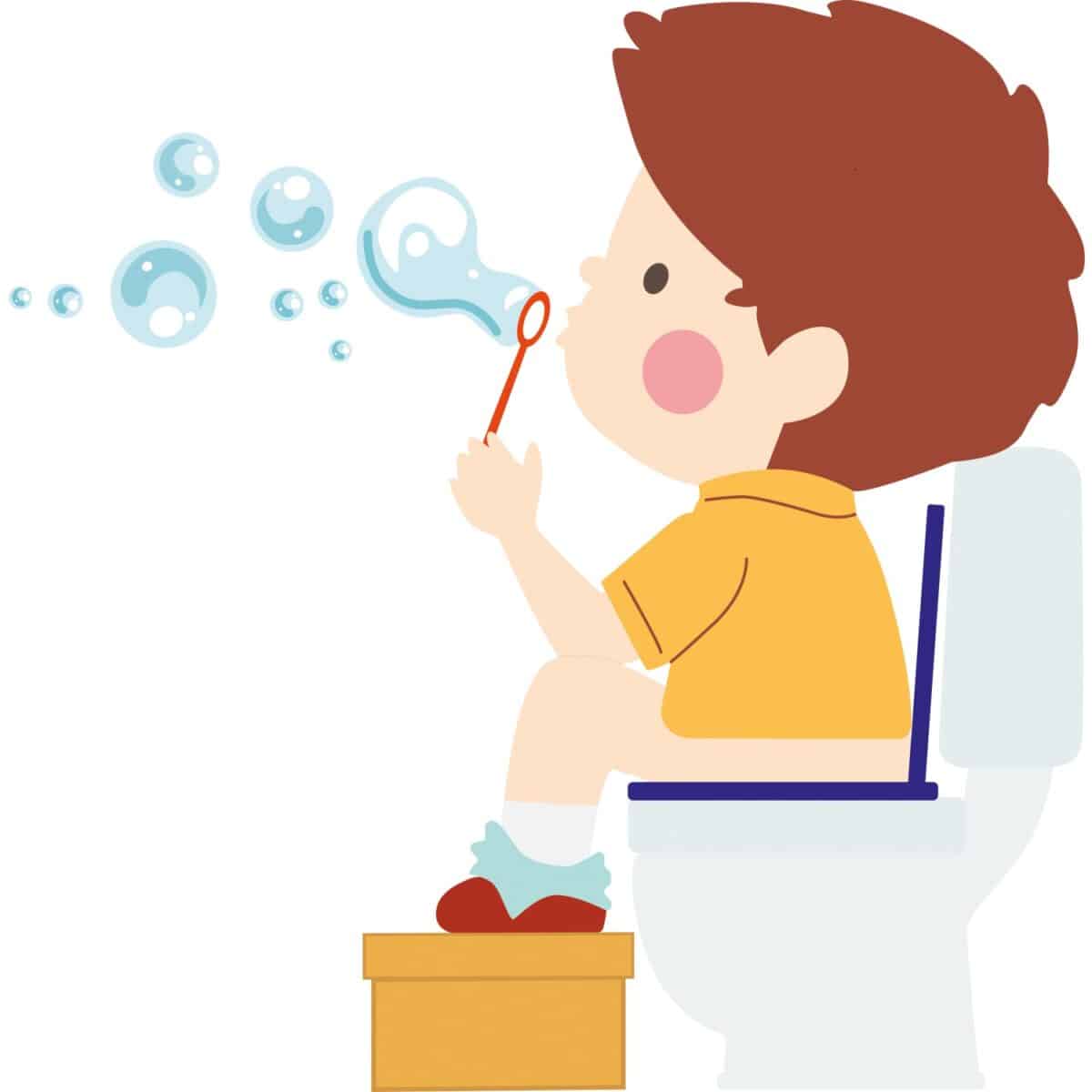
- Feet flat and firmly supported on a box or stool, knees higher than hips.
- Secure sitting position - they will need a children's toilet seat when they use the toilet.
Sitting in the right way means the bowel and bladder can empty better, as well as enabling your child to relax. Little boys should therefore be encouraged to sit down to do their wees – plus they might need a poo.
Getting there at the right time will maximise the chance of success:
- The ideal time for poos is 20 – 30 minutes after meals, when the guts are naturally squeezing more quickly.
- The ideal time for wees depends on when the bladder is full as it is the stretching of the bladder muscles that activates the correct emptying process. Don’t limit your child’s drinks to try and keep them dry, and don’t take them to the toilet too frequently as then the bladder will never be full. Check your child’s nappy to work out the interval between their wees, and use that as your guide to timetable potty sits.
Developing skills
The potty practice phase will obviously last some time, and you will respond to your child’s changing needs and abilities as they grow. Here are some tips to help them progress:
- Talk about the wee and poo that your child passes to help them learn words and signs, so that they can eventually communicate their needs to you. Ensure consistency between different members of the family/caregivers to avoid confusing your child.
- Involve your child in dressing and undressing at potty and nappy changing times, changing them standing up as soon as they are able.
- Try and include some nappy-free time. Take the opportunity when you know they have done a wee and poo to have half an hour practising wearing pants.
- When the time is right, help your child to learn to wipe their own bottom. Look at Learning bottom wiping: a step-by-step guide.
Stopping using nappies
Stopping using nappies will be a big change for your child, however well prepared they are, and however much potty practice they have done.
So when is the right time to say goodbye to those nappies?
Every child is different so be guided by their progress with Step 1 – Preparation and Step 2 – Practice, and on your family situation.
Avoid stopping using nappies at a time when there are any big changes or disruptions anticipated, such as a change in childcare or a new baby about to arrive.
Make sure it is a clear distinction: goodbye nappies, hello pants. Chopping and changing between nappies/pull ups/pants will simply confuse your child.
Choose a time when you and your child can be at home together for the first few days, where there are fewer distractions.
Go for it – and be ready to be patient, persistent and positive!
After the first few days at home, you’re ready to go out and about. Resist the temptation to put a nappy on. Instead, pack the potty and changes of clothes and protect the pushchair or car seat. Look in the ERIC Online Shop for things like portable potties and car seat protectors.
Nursery and school
For potty training to go well, your child needs a consistent approach to help them learn what they need to do whether they are at home or in childcare.
If your child starts a new childcare setting, talk to staff straight away about monitoring bladder and bowel health including noting wees, poos and drinks.
Prepare together, plan potty practice and eventually choose a good time to stop using nappies that works at home and in the setting.
With timely potty learning, most children will be confidently wearing pants long before they start school.
Sometimes, things take a bit longer, maybe due to constipation or a bladder problem, or maybe because your child has some additional needs.
Communicate with their school in good time so they are ready to support your child. Involve your child’s health care professional, such as their Health Visitor or School Nurse, and anyone else who helps care for your child such as a Family Support Worker.
Help the school to understand how to meet your child’s needs – read Using the toilet at school.
Sometimes a child who has done well with potty training seems to regress when they start school. Maybe they are too scared to go to the toilet, so they don’t drink and start withholding.
Check what your child is drinking at school, talk about the school toilets and whether they are using them and monitor their bowel habits at home. It’s better to spot changes and manage them early before a problem develops.
What about night time?
Some children are dry at night soon after achieving success in the daytime, for others it is much later. If your child is still wet at night, don’t worry. It is normal for young children but if they are still wet beyond 5 years old, treatment is available.
The first step is to work on healthy bladders and bowels – so keep an eye on drinking and always watch for constipation.
Make sure your child gets into the habit of having their last drink an hour before bedtime – if they wake for a drink in the night only offer water. Always guide them to do a wee last thing before sleep.
Protect their mattress with a waterproof cover so accidents don’t matter – look in the ERIC Online Shop.
If wetting persists, look at Advice for children with night time wetting.
What if it all goes wrong?
Don’t worry! Even with perfect preparation and practice, some children do struggle. Look for more information on the ERIC website, and if you can’t find what you need contact the ERIC Helpline.
More info
- Children who will only poo in a nappy and other toilet avoiders
- Toilet anxiety and toilet phobia in children
- Stool withholding: why & how to stop a child holding poo
- Advice about bladders, bowels and toileting for children with additional needs - ERIC
- Information in other languages
- Read this page in Welsh: Cyngor ynglŷn â phledrenni a choluddion plant o’r geni, i hyfforddiant poti, i’r Ysgol / Advice about children’s bladders and bowels – from birth, to potty training, to school
Last Reviewed: January 2026
Next Review: January 2029
On this page...
Upcoming events
Share this page