
Need further support?
Children’s bladder health – what’s normal and what can go wrong
Is your child experiencing wee problems? Are they rushing to the toilet, having wee accidents or abnormal wees? If so, the starting point is to promote a healthy bladder by working through the steps on this page.
It’s really important to know how the bladder works, what healthy wee should look like and how to promote a healthy bladder. If we look after our children’s bladders, we are also looking after their kidneys, which is vital for their general health and wellbeing.
Bladders often misbehave in childhood, but it can be difficult to talk about wee problems, especially if we are not really sure what is normal.
This page explains how the bladder works and the 4 steps to a healthy bladder. There’s also information on how to recognise bladder problems, and what to do about them.
Read our advice sheets Advice for children with constipation, Advice for children with daytime bladder problems, Advice for children with night time wetting, Advice about children’s bladders and bowels – from birth, to potty training, to school and Advice about bladders, bowels and toileting for children with additional needs for more information, including downloadable PDFs of the advice sheets.
How the bladder works
The water we drink, and all the water we consume as part of everything else we eat and drink, is absorbed into the bloodstream from the large bowel, or colon. The blood is then pumped through the kidneys, which filter out the waste. This waste is known as urine, or wee or pee.
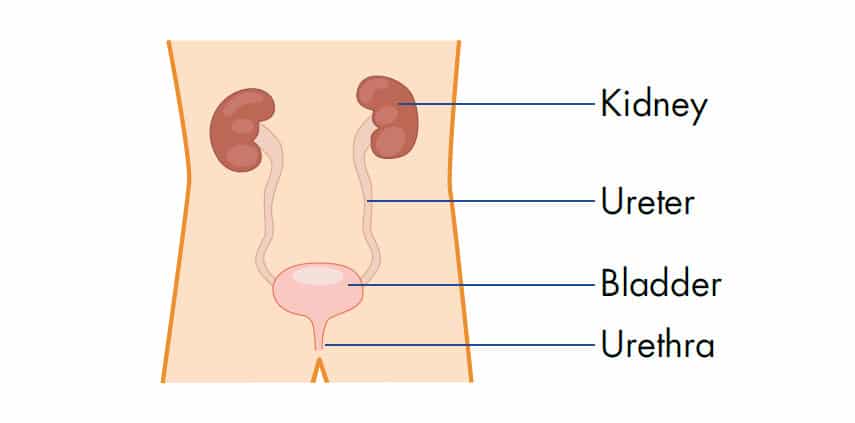
The urine travels down long, thin tubes called ureters into the bladder, which is a balloon-shaped bag made of muscle. As it fills with urine it stretches, which sends a message to the brain saying it’s time to do a wee.
There are actually two sets of muscles to do with bladders:
- The stretchy-squeezy muscles of the balloon: these have to relax to allow the bladder to stretch to hold all the wee, and then squeeze when we go to the toilet.
- The holding on muscles: these have to hold on tight most of the time, but relax and open when we go to the toilet, and stay open while all the wee is squeezed out.
Our brain controls the bladder by sending messages along the spinal cord and the nerves, telling it when to hold on and when to empty. The two sets of muscles have to work in coordination to hold the wee in, or to squeeze it out.
When it is time to do a wee, the urine drains from the bladder via a tube called the urethra. The urethra is very short in girls, but much longer in boys.
What is a healthy bladder?
- A healthy bladder stores wee at a low pressure
- It empties between 4 and 7 times a day in school-aged children, and more frequently in younger children
- When it stretches and sends a message to the brain to say it is full, there should be plenty of time to get to the potty or toilet
- A healthy bladder empties completely when the child voids
- It should not leak between voids (wees)
What does healthy wee look like?
Healthy wee is very light in colour – almost colourless – except first thing in the morning. Our first wee of the day will be more concentrated as we have not been drinking, and because the body concentrates the wee at night.
Darker wee later in the day suggests the child is not drinking enough.
Look at our Wee Checker with your child and help them to decide if they have got a happy, healthy bladder, or if their bladder and kidneys are getting worried.
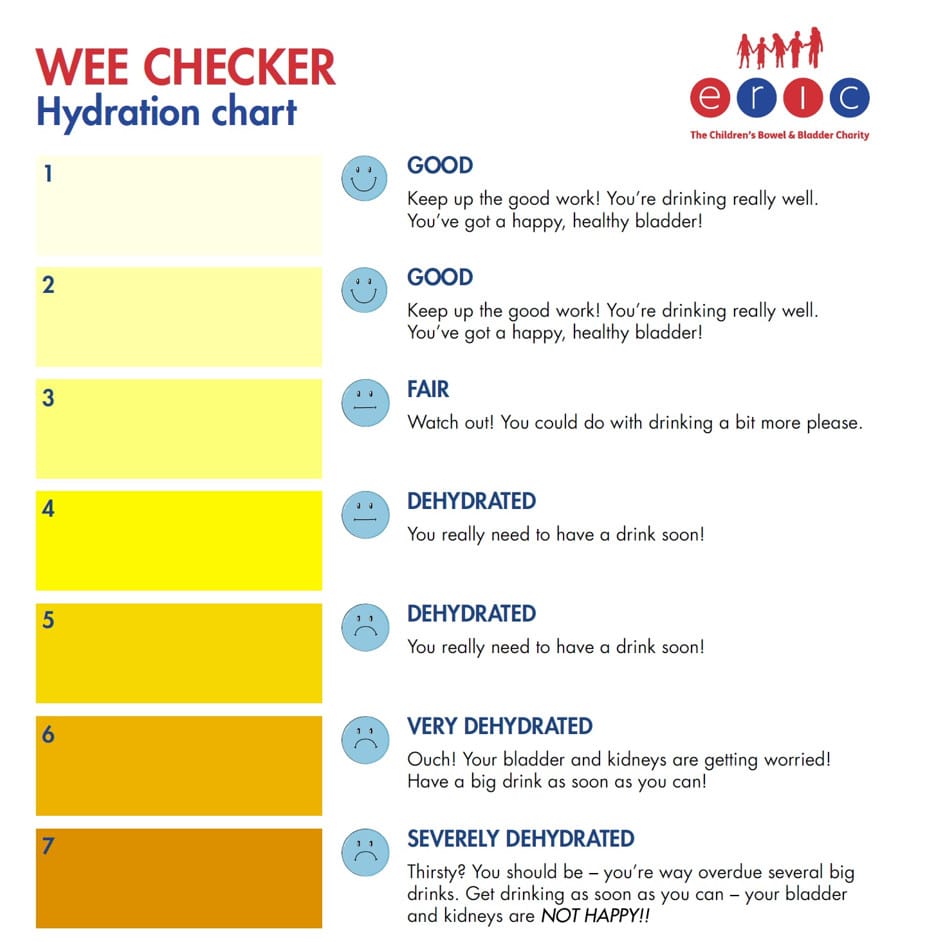

Wee should never be smelly – smelly wee usually means it is too concentrated, but it could suggest a Urinary Tract Infection (UTI).
How much should children drink?
All children should have a minimum of 6 – 8 cups of drink a day, of a suitable cup size for their age – so about 120mls for a 2-year-old, 200mls for a 7-year-old. Drinks should be spread out throughout the day – the bladder is made of muscle, and like all muscles it needs regular exercise to keep it fit.
Whenever it is hot, or the child is running around a lot, they need extra drinks.

The 4 steps to a healthy bladder
1. Check out your child’s poo
People often think that wee and poo are totally separate, but although they are completely different systems, the bladder and bowel are so close together that the bowel can really affect the way that the bladder behaves.
A full bowel occupies the space where the bladder wants to expand and fill. That means the bladder is squashed and can’t hold onto very much wee – so your child might do frequent, small wees. The full bowel bumping into the bladder can make it squeeze when it shouldn’t, leading to a feeling of urgency, and potentially day and/or night time wetting.
So when you’re thinking about your child’s bladder, always start by looking at the Poo checker to help you to identify your child’s poo, and note how frequently they are going. A full bowel - constipation - is really common in childhood, so always suspect it – and take action. Children do not grow out of constipation.
Have a look at Advice for children with constipation for more information on how to spot it and what to do about it.
2. Think about the possibility of a Urinary Tract Infection (UTI)
Bugs in the wee can make the bladder misbehave – but they don’t always make the child ill.
So how would you know?
First of all think about whether the bladder behaviour has changed. For example, have they recently started having damp patches in their pants, or wetting the bed? If the bladder misbehaviour has always been the same, it is less likely to be caused by UTI.
Then have a good look at your child’s wee. Get them to wee in the potty if they will still fit on it, or catch some wee in a container placed in the toilet. The wee should not be smelly, or cloudy, or bloodstained. If it is, check out our info on UTIs.
3. Get the drinking right
As well as the right quantity, and spreading the drinks out, we also need to think about what your child is drinking. We all know that water is best, but however hard you try some children just don’t drink enough of it! So what else can you give them?
Milk is fine in moderation – don’t give them milk all the time or they will fill up on it, and eat less proper food and drink fewer water-based drinks.
Fruit juice or squash can be included too, but always very well diluted – think water with a dash of juice or squash. You could also try flavouring water with fresh fruit, either chopped or puréed.
Avoid caffeine – as it is a stimulant, it might make your child’s bladder squeeze when it shouldn’t. If your child enjoys a cup of tea or coffee, help them to choose decaffeinated options.
Some children’s bladders are irritated by artificial colourings, flavourings or sweeteners, or by blackcurrant, orange or fizzy drinks. Rather than banning all these, do some trials with your child –
- Have a week when they only drink water, milk in moderation and well-diluted apple juice, and note how the bladder behaves – for example, how many wetting episodes? How many dashes to the toilet?
- Then add one of the potential irritants, such as orange, and once again note how the bladder behaves over the week. If it made no difference, your child can continue drinking it – and you can trial another potential irritant.
If you’ve offered a variety of drinks and your child’s intake still isn’t enough…
- Think about foods with a high water content like fruit, jelly, soup, salad and yoghurt
- Try and avoid asking your child if they would like a drink, or if they are thirsty. Simply say: “It’s drink time!”
- Make drinks fun with straws and ice cubes – have a look at Tips for better drinking for more ideas
- Use ERIC’s Drinking Reward Chart to plan a drinking timetable with your child. Start with a couple of drinks first thing in the morning to wake up the bladder with some exercise!
4. The importance of relaxing to wee
When it is time to do a wee, messages from the brain tell the two sets of bladder muscles what to do to let the wee out. But unless we relax, the messages can’t get through.
How your child sits on the toilet has a big impact on their ability to relax. Imagine trying to do a wee or poo if your feet don’t touch the floor, there’s a big, oversized seat and your bottom is falling though the big hole, and you’re holding on tight with both hands!
So, what should you do to help them? If your child is small enough to sit on a potty, that’s fine. When they use the toilet, help them to use a children’s toilet seat so they can sit safely and comfortably. A box or stool under their feet should be high enough to raise their knees above the level of their hips, whilst their feet stay flat.
Encourage boys to sit down as well as girls – it is much easier for them to relax sitting down, and it helps the bladder to empty as much wee out as possible. Plus they might not have noticed that they need a poo!
A basket or bag of washable toys makes sitting on the toilet much more fun! Sit with your child and tell stories together. And take your time – if your child is keen to get off the toilet, try sand timers, gradually building up to longer sits.
Think about your child’s sensory needs. For example, is your bathroom a relaxing place to be? Or is it cold, with bright lights and strange smells? Have a look at Sensory needs and toileting
Take time to adapt the bathroom, to create the right environment for your child.
Watch the following video - one of our Family Service advisors talking through advice and tips for making toilet time a more relaxing and enjoyable experience for your child.
This is a 30 minute recording of a webinar recorded in October 2023. Auto-generated captions can be turned on by clicking on the CC icon in the viewing window below.
Misbehaving bladders
Sometimes problems persist even when your child is doing really well with their 4 steps to a healthy bladder.
How might the bladder misbehave?
- Frequency – in other words needing a wee too often. Remember 4 – 7 wees a day is normal for school aged children
- Not weeing often enough
- Urgency – in other words suddenly being desperate to wee
- Small volume wees, or giant wees
- Wetting – which could be a large or small amount, during the day and/or during the night
Look at Daytime bladder problems to find out what to do next.
What might cause bladder misbehaviour?
Weeing too frequently / urgency / small wees / wetting could be caused by:
- Constipation
- UTI
- Concentrated wee irritating the bladder
- Drinks containing caffeine or a bladder irritant
- If all these have been ruled out, your child might have an overactive bladder
Not weeing often enough might be due to:
- Inadequate fluid intake
- Large bladder capacity
- Wee withholding
If wetting only happens at night, look at Advice for children with night time wetting
If wetting only happens when your child is laughing, look at Giggle incontinence
If your child suddenly starts to wee very frequently, and maybe starts wetting during the day or night, especially if they seem unusually thirsty, it is possible that they have Type 1 Diabetes. Make an appointment to see your GP as soon as possible.
Look at Daytime bladder problems for more information.
So, however your child’s bladder is misbehaving, remember that the first thing to do is to take time to really work on the 4 steps to a healthy bladder. Don’t expect immediate results. Allow at least a month of no constipation, no UTI, great drinking and regular, relaxed wees - before considering what to do next.
Last Reviewed: October 2025
Next Review: October 2028
Resources
- All
- At school
- Drinking tips
- Factsheets
- For Teens
- Kid's stuff
- Treatment
- Useful products
- Videos
More information

Wee withholding
Find out why some children avoid emptying their bladder, whether this can do any harm and how to help your child.
Giggle incontinence
Information on how to identify and manage giggle incontinence.
Bedwetting
Information and practical tips about treating this common childhood condition and ways to make life a little bit easier.
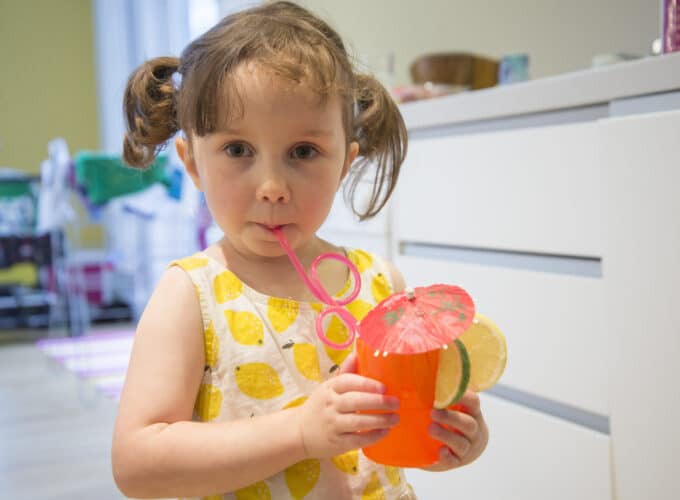
Tips for better drinking
Tried and tested methods to get children to drink more and stay hydrated.
Complex bladders
Our guide has information about the different treatment options and equipment for children with complex bladder problems.
On this page...
Upcoming events
Share this page